

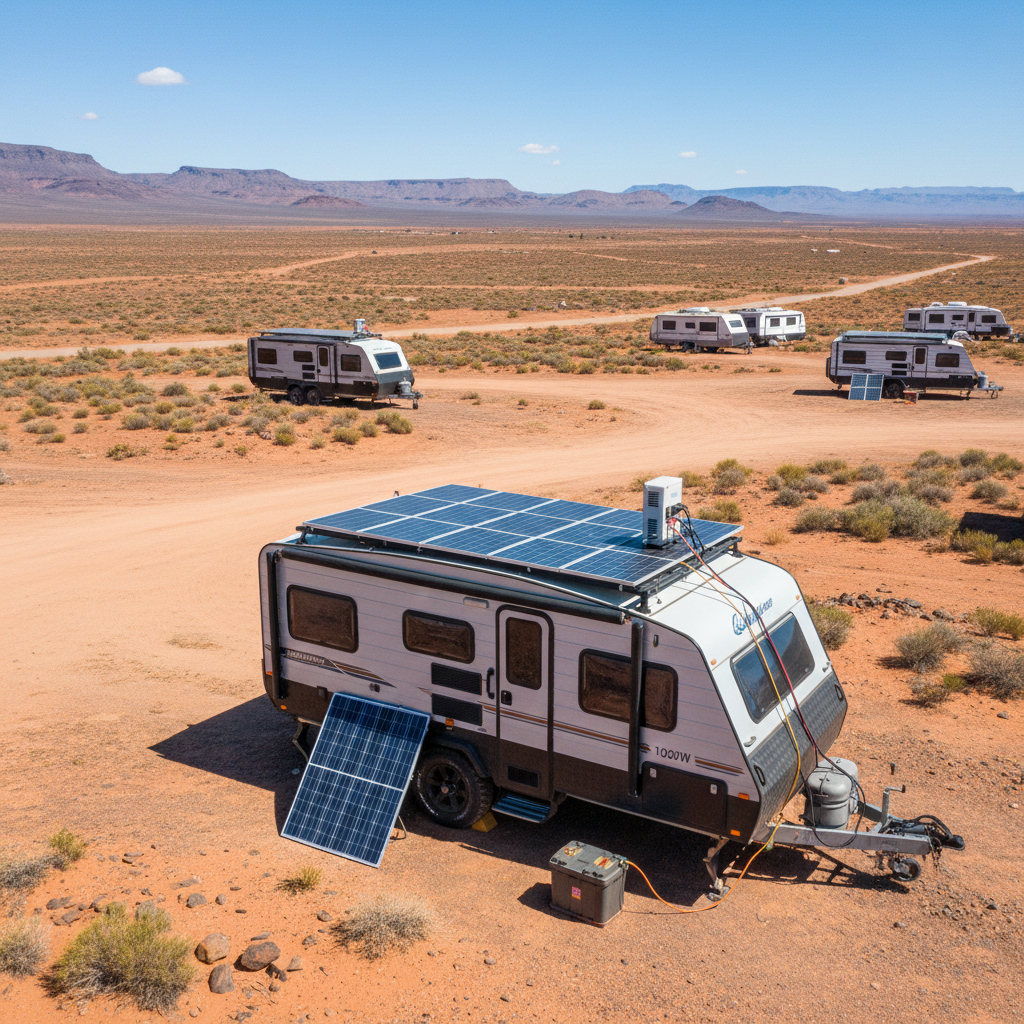
Remote camping in Australia can mean weeks away from powered sites. Your fridge, lights, water pump and chargers all draw from one battery bank. If it runs flat at a desert camp or station stay, the food spoils and the lights go out.
Many buyers compare campervans for sale in Australia with camper trailers and find both rely on similar 12-volt systems. A trailer has one extra challenge. It often sits at camp for days while the tow vehicle heads out, so it must generate and store its own power.
This guide covers solar sizing, lithium batteries, DC-DC chargers, inverters and practical tips. Use it to build a system that keeps running far from mains power.
Work Out Your Daily Power Use
Start with an energy audit. List each appliance, its current draw in amps and its daily running hours. Multiply these figures to get amp-hours (Ah).
- Compressor fridge: 30 to 40Ah in summer
- LED lights: around 5Ah
- Water pump: 2 to 5Ah
- Phones and devices: 5 to 10Ah
Most couples use 50 to 80Ah per day. Add a 20 percent buffer for hot weather and cloudy days.
Size Your Solar Panels
Heat, shade and low winter sun all cut panel output. As a rough guide, each 100 watts of panel delivers around 25 to 30Ah per day in good conditions.
- 200W suits light users on short trips.
- 300 to 400W covers most couples running a fridge full time.
- Combine panels. Fit a fixed roof panel for charging on the move, plus a portable folding panel you can place in full sun.
Pair your panels with an MPPT solar controller. It converts more panel output into battery charge than a basic PWM unit, especially in high temperatures.
Why Choose Lithium Batteries
Lithium iron phosphate (LiFePO4) batteries now power most new camper trailer builds.
- More usable capacity. You can draw 80 to 100 percent safely, compared with about 50 percent for AGM.
- Less weight. Lithium weighs roughly half as much as an equivalent AGM bank, which frees up payload.
- Longer life. Expect 2,000 to 5,000 charge cycles.
- Steady voltage. Appliances run efficiently until the battery is nearly empty.
A 200Ah lithium battery suits most couples. Choose one with a built-in battery management system and low-temperature charge protection for alpine trips.
Fit a DC-DC Charger
Your tow vehicle can charge the trailer while you drive. Many modern vehicles use smart alternators with variable voltage, which undercharge lithium through a direct connection. A DC-DC charger regulates that voltage to the correct lithium profile. Many models include an MPPT solar input, combining both charging sources in one unit. Run heavy-gauge cable to reduce voltage drop.
Choose the Right Inverter
An inverter converts 12V DC into 240V AC for laptops, camera chargers and small appliances. Choose a pure sine wave model to protect sensitive electronics. Size it to your largest load, and limit high-draw items. A 1,000W inverter at full load pulls around 85 amps from a 12V battery.
Practical Off-Grid Tips
- Park in shade and move your portable panel into the sun.
- Angle panels north for better output.
- Clean panels after dusty outback roads.
- Pre-cool the fridge on mains power before you leave.
- Fit a battery monitor to track state of charge.
- Protect every circuit with fuses, and use a qualified auto electrician for installation.
Audit your daily usage, then size solar and storage to match. Pair 300 to 400W of solar with a 200Ah lithium battery, an MPPT controller and a DC-DC charger. Add a pure sine wave inverter only for the loads you need. Test the full system on a short trip before heading remote.